China Top 10 Counterbalanced Forklift Manufacturers

Time:2026-09-28 Author:Isabella
0%

China’s counterbalanced forklift sector includes established equipment groups and specialized manufacturers serving warehouses, factories, ports, and outdoor yards. This guide introduces ten Chinese manufacturers worth evaluating when buyers compare lifting capacity, power options, mast designs, and after-sales support. The list is a practical starting point, not an official industry ranking. Fit matters more.

A counterbalanced forklift carries its load beyond the front axle, so stability, visibility, and operator controls deserve close attention. Buyers should compare rated capacity at the required load center, turning radius, tire choice, battery or engine configuration, and service coverage near the worksite. Ask for current product specifications and confirm that quoted performance matches the intended duty cycle. Paper figures can look tidy. Real shifts are messier.

Manufacturer experience is only one part of a sound decision. Inspect build quality, request a demonstration with a representative pallet, and discuss parts availability, warranty terms, and technician response times. Where possible, review references from similar applications rather than relying on a brochure alone. This overview highlights companies and evaluation points, but it cannot replace a site assessment or independent verification. Even a well-known brand may be a poor match for a narrow aisle, uneven ground, or intensive multi-shift use. Treat the shortlist as a prompt for questions, not a final verdict. Careful comparison still takes work.
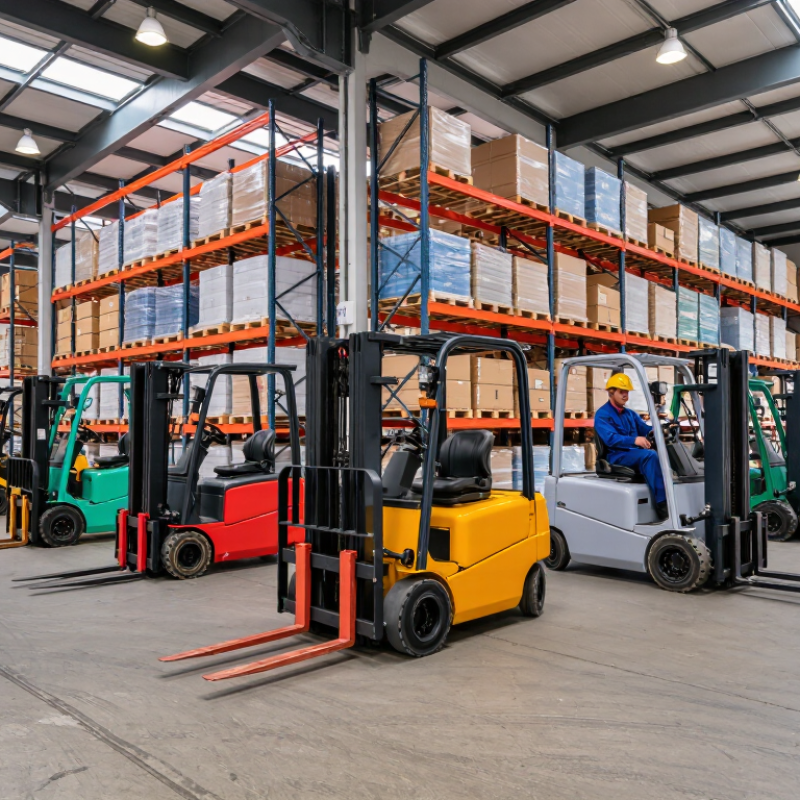
China Top 10 Counterbalanced Forklift Manufacturers

Counterbalanced Forklifts in China: Market Scope and Key Segments

China’s counterbalanced forklift market covers machines that carry loads ahead of the front axle, using rear counterweight to balance them. This layout suits warehouses, factory floors, loading bays, and outdoor yards where loads must be lifted without support legs extending forward. The market includes compact electric models for indoor handling and combustion-powered units commonly selected for longer shifts or outdoor work. That matters.

Key segments differ by rated capacity, energy source, tire type, and working environment. Smaller trucks often handle palletized goods in narrow aisles, while higher-capacity models move heavier materials across larger sites. Solid tires can suit smooth floors and reduce puncture concerns; pneumatic tires offer more cushioning on uneven surfaces. Buyers also compare lift height, turning radius, battery charging needs, and service access. Specs can mislead.

In China, manufacturers serve domestic industries such as logistics, manufacturing, construction materials, and port-related operations, while also producing equipment for export markets. Product ranges and configurations vary, so a model’s label alone does not show whether it fits a particular job. Measure aisle width, floor condition, average load, and daily operating hours before comparing quotations. One limitation remains: published segment boundaries are not always consistent, making direct market comparisons harder than they appear.

Criteria for Identifying China’s Leading Manufacturers

Choosing a leading Chinese counterbalanced forklift manufacturer requires more than checking output or export volume. The 2023 annual statistics from the Industrial Truck Branch of the China Construction Machinery Association recorded 1,173,797 industrial truck sales nationwide. This figure signals industry scale, not counterbalanced-forklift quality. Compare sales by truck type, rated capacity, and destination market. Scale isn’t proof. Ask for model-specific test records, not just company-wide totals.

Technical evidence matters. Check rated capacity at the stated load center, residual capacity at working lift heights, turning radius, braking performance, and mast visibility. A truck rated for 3 tonnes may carry less safely when its load sits farther forward. Use ISO 3691-1 as a reference when reviewing safety verification, and confirm which tests apply to the specific model. Inspect a unit with a pallet raised; look for clear sightlines, stable steering, and smooth lowering. Test it live. Also review parts availability, technician coverage, and response times in the intended service region. Catalog figures can flatter a machine; I would still want an observed test, since published specifications rarely show performance on an uneven warehouse floor. That extra check may feel slow, but skipping it can leave important gaps.

Profiles of 10 Major Chinese Counterbalanced Forklift Manufacturers

China’s counterbalanced forklift sector includes manufacturers serving factories, ports, warehouses, and outdoor yards. These ten profiles compare production focus, equipment range, and practical support rather than relying on promotional claims. Some producers offer broad capacity options, while others concentrate on electric models, heavy loads, or specialized configurations. Their strengths are not interchangeable.

The profiles also consider details buyers can verify: rated capacity, load-center distance, turning radius, mast height, battery or engine options, and local parts availability. A maker with a wide catalogue may suit mixed operations; a more focused producer may offer a closer match for repetitive tasks. Product specifications vary by model, so confirm them against the actual configuration. A brochure alone is not enough.

Tips: Ask for a load chart and service schedule. Check turning space with your real aisle dimensions. Request references for similar duty cycles, and inspect a unit before purchase when possible. Small differences matter. I would also compare warranty terms carefully; they can be easy to overlook.

China’s Counterbalanced Forklift Sector: Common Rated Capacity Options

Typical nominal load-capacity ratings for counterbalanced forklifts, shown in metric tonnes.

These are commonly encountered capacity ratings, not manufacturer sales figures, market shares, or a ranking of companies. Actual capacities vary by model and configuration.

Product Ranges, Power Systems, and Core Technologies

Counterbalanced forklift makers typically offer compact 1–3-tonne models for indoor work, 3–5-tonne machines for general handling, and heavier units for yards and industrial loads. Their ranges differ in mast height, tire type, chassis width, and attachment options. Small details matter: a few centimetres of aisle clearance can change which truck fits a warehouse. World Industrial Truck Statistics (WITS) tracks industrial-truck shipments by equipment category, helping buyers compare market trends rather than relying only on catalogue claims.

Power systems shape operating costs and site suitability. Electric models use lead-acid or lithium-ion batteries; combustion models commonly use diesel or LPG. The IEA’s Global EV Outlook 2024 reported that electric-car battery demand reached about 750 GWh in 2023, up 40% year on year. That is not forklift data, but it shows how quickly battery supply chains are expanding. Core technologies now include AC drive motors, regenerative braking, battery monitoring, and stability controls. Useful, but not magic. Buyers should test lift cycles, charging access, and visibility with real loads. One caveat: published capacity figures may not reflect performance at maximum lift height. A site trial can reveal what a spec sheet misses.

Applications, Service Networks, and Manufacturer Selection

Counterbalanced forklifts are common in warehouses, factories, and loading yards because they carry loads without front support legs. Their real performance depends on the job. A 2.5-tonne unit may suit pallet handling, yet struggle on rough paving or with a tall, unstable load. Check load charts, lift height, aisle width, turning radius, tire type, and shift length against actual site conditions. Measure the tight spots. Battery models can work well indoors, while diesel or LPG options may fit outdoor duty, depending on ventilation and operating rules.

Service coverage matters as much as the specification sheet. Ask how quickly technicians can reach your site, which parts are stocked locally, and whether routine maintenance can happen during quieter shifts. Request sample service records and clear warranty terms. A broad network sounds reassuring, but response times and technician training need verification. Ask practical questions.

When comparing manufacturers in China, assess build quality, component sourcing, operator visibility, and the availability of manuals and training. Arrange a supervised test with your typical pallet and floor surface; observe braking, mast movement, and control response. Compare total ownership costs, not just purchase prices. Include energy, tires, planned maintenance, and likely downtime. A checklist helps, though real sites rarely behave neatly. One detail we might overlook is how operators feel after a full shift; collect their feedback before choosing.

China Top 10 Counterbalanced Forklift Manufacturers - Applications, Service Networks, and Manufacturer Selection

The entries below are anonymized manufacturer profiles, not a verified ranking of named companies. Capacity ranges and application descriptions are typical market-level guidance; actual specifications, service coverage, and availability vary by model and supplier.

Profile Typical Counterbalance Segment Common Applications Powertrain Options to Check Service Network Considerations Key Manufacturer Selection Checks
Profile 1: General-purpose warehouse supplier Typically 1.5–3.5 t Pallet handling, loading bays, and indoor/outdoor yard work on suitable surfaces Electric, LPG, or diesel, depending on model and operating environment Check local technician availability, parts stock, response times, and warranty support. Compare rated capacity at the required lift height, turning radius, visibility, and attachment compatibility.
Profile 2: Electric-focused supplier Commonly 1.5–5.0 t Indoor logistics, manufacturing, and operations where reduced onsite exhaust emissions are important Battery-electric; confirm battery chemistry, charger, and charging requirements for the exact model. Ask about battery diagnostics, charger support, replacement batteries, and trained electrical technicians. Assess shift duration, charging or battery-changing arrangements, floor conditions, and total energy cost.
Profile 3: Internal-combustion-focused supplier Often 1.5–10 t, depending on the range offered Outdoor yards, docks, and applications with longer operating periods or refueling needs Diesel or LPG; availability and suitability depend on model, local regulations, and site conditions. Verify engine and transmission service capability, consumables availability, and scheduled-maintenance coverage. Review emissions requirements, fuel access, tire choice, and performance on the intended surface.
Profile 4: Heavy-duty supplier Typically above 5 t; heavy-duty ranges may extend beyond 10 t Steel, timber, port, construction-material, and other heavy-load handling, subject to configuration Usually diesel or other specified industrial power options; confirm model-specific availability. Check access to heavy-equipment technicians, lifting equipment, major components, and onsite service. Verify load center, residual capacity, mast configuration, axle loading, and attachment ratings.
Profile 5: Compact and space-conscious supplier Often around 1.0–2.5 t Smaller warehouses, workshops, retail backrooms, and congested production areas Frequently electric; some ranges may include internal-combustion models. Confirm local parts availability for compact models and support for the selected battery or engine system. Measure aisle width and turning space; check overall width, mast height, and load capacity at lift.
Profile 6: Rough-terrain application supplier Commonly 2.5–5.0 t for relevant rough-terrain configurations Construction sites, outdoor storage, and uneven ground when the truck is specifically designed and rated for those conditions Typically internal combustion; confirm the exact drivetrain, tires, and ground-clearance specification. Look for regional field-service capability and access to tires, filters, and drivetrain parts. Confirm terrain suitability, gradeability, tire type, stability limits, and safe operation requirements.
Profile 7: Attachment and customization supplier Often 1.5–10 t, with capacity dependent on the truck and attachment Paper, beverage, appliance, and other material-handling tasks requiring clamps, rotators, or specialized forks Electric or internal combustion, depending on duty cycle and available configuration Check hydraulic-service capability, attachment parts support, and access to trained installation personnel. Request a capacity calculation for the attachment, load center, lift height, and intended load.
Profile 8: Export-oriented supplier May cover compact through heavy-duty classes; confirm the product range offered for the destination market. Importers, distributors, and fleet buyers operating across multiple markets Options vary by market; verify voltage, engine specification, tires, and configuration before ordering. Assess dealer coverage, parts lead times, technical documentation, and warranty handling in the destination country. Check applicable conformity documents, manuals, parts catalogues, shipping terms, and product support commitments.
Profile 9: Fleet and telematics-oriented supplier Typically available across several capacity classes; exact range is model-dependent. Multi-truck fleets seeking utilization, maintenance, or operational data Electric and/or internal-combustion models; data features vary by truck and system. Confirm software support, connectivity in the operating region, and local service access for electronic systems. Review data access, subscription terms, integration needs, maintenance plans, and operator-training options.
Profile 10: Value-focused supplier Commonly focused on mainstream 1.5–3.5 t models Standard pallet movement and general material handling where purchase cost is a key consideration Power options depend on the model; compare equivalent configurations rather than headline prices alone. Verify warranty scope, service labor rates, consumables, parts lead times, and support after the sale. Compare total cost of ownership, safety equipment, build specification, operator comfort, and resale support.

FAQS

How do I choose the right forklift capacity?

Match rated capacity to your heaviest load and its load-center distance. A 2.5-tonne model may struggle with tall or unstable pallets.

Which site measurements should I check?

Measure aisle width, turning space, lift height, and tight corners. Measure the tight spots.

Are electric forklifts suitable for indoor work?

Battery models can suit indoor operations. Check shift length, charging needs, and the site’s operating conditions.

What should I check for outdoor use?

Consider tire type, floor surface, and operating conditions. Diesel or LPG options may suit some outdoor duties.

How can I assess service support?

Ask how quickly technicians can reach your site and which parts are stocked locally. Request sample service records and clear warranty terms.

Should I test a forklift before buying?

When possible, arrange a supervised test with your usual pallet and floor surface. Watch the braking, mast movement, and control response.

What costs should I compare beyond the purchase price?

Include energy, tires, planned maintenance, and likely downtime. A low purchase price may not tell the whole story.

Why ask operators for feedback?

They can describe visibility, controls, and comfort after a full shift. I might overlook fatigue if I only read the specification sheet.

Conclusion

This article explores China’s counterbalanced forklift market, outlining its scope and the key segments shaped by lifting capacity, power source, operating environment, and application. It also explains how leading manufacturers can be assessed through factors such as product quality, engineering capability, production capacity, safety features, and after-sales support. The profiles of ten major Chinese manufacturers offer a structured overview of the industry without focusing on individual brand promotion.

The article compares product ranges, including electric and internal-combustion models, and reviews core technologies that affect performance, efficiency, and operator comfort. It also considers how counterbalanced forklift trucks serve settings such as warehouses, manufacturing facilities, and outdoor material-handling operations. Finally, readers will find practical guidance on evaluating service networks, matching equipment to workplace needs, and selecting a manufacturer based on reliability, support, and long-term operating requirements.

Isabella

Isabella

Isabella is a dedicated marketing professional with a sharp focus on driving brand growth and engagement through strategic content creation. With an extensive background in digital marketing, she combines her passion for storytelling with her keen understanding of industry trends to deliver......